
Many Toronto homes — particularly those built before the 1970s in neighbourhoods like The Annex, Riverdale, Roncesvalles, and Forest Hill — still have original fuse boxes. Fuse boxes and breaker panels both protect your wiring from overload, but the practical differences matter for safety, insurance, and capacity. Here's what every Toronto homeowner should know.
Quick Answer
Fuse boxes are outdated and create real problems for Toronto homeowners — insurance surcharges, limited capacity, and the fire risk of over-fusing. Most homes with fuse boxes also have 60A service, which is not enough for modern appliances. If your home has a fuse box, a panel upgrade is the right move — not a matter of if, but when.
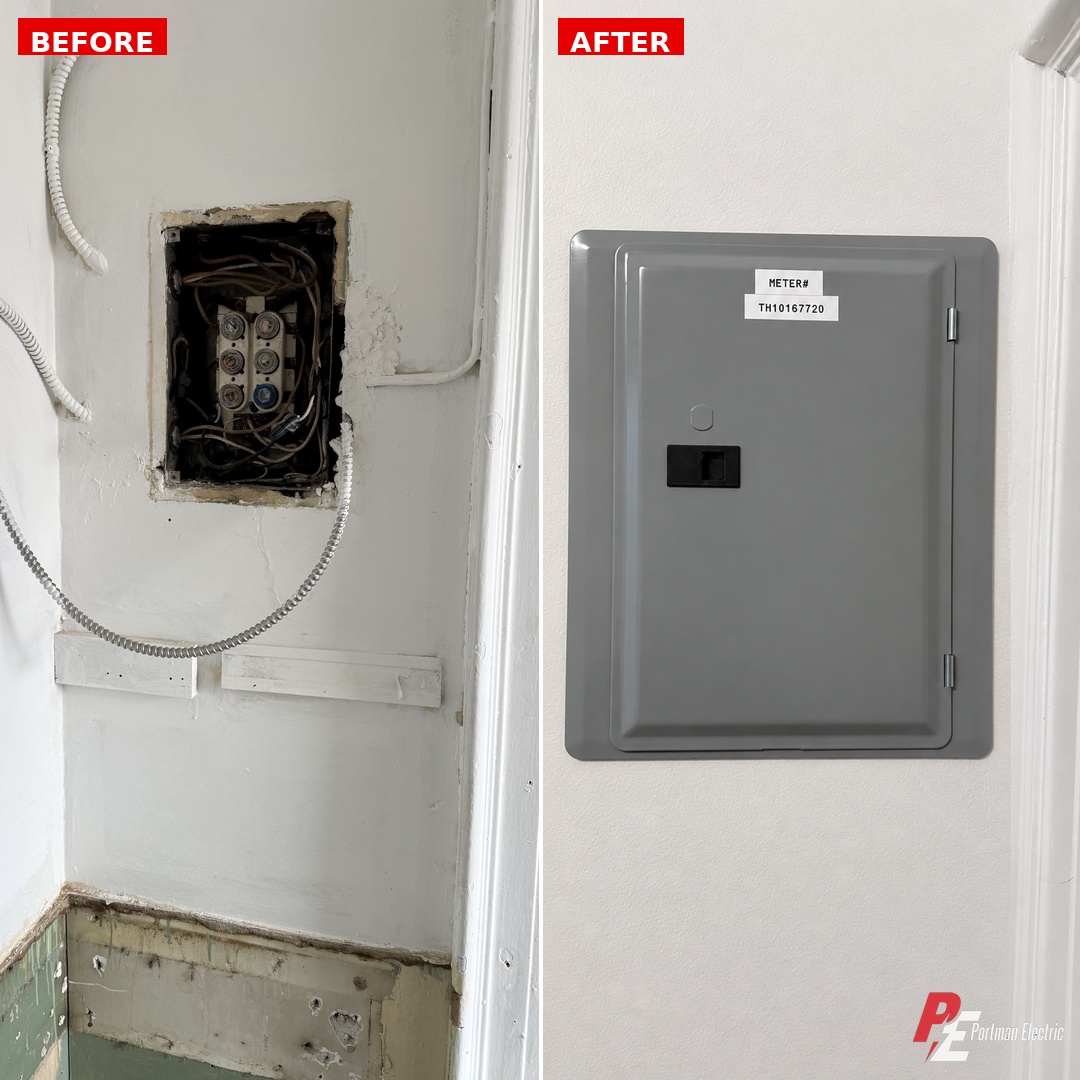
Before: an exposed, deteriorated fuse box in a Toronto home. After: a clean, properly installed modern breaker panel — permitted and ESA-inspected.
How Fuse Boxes Work vs Breaker Panels
Both fuse boxes and breaker panels do the same job: they protect circuits from carrying more current than the wiring can safely handle. The difference is in how they respond to an overload.
Fuse Box
Uses glass or ceramic fuses that physically burn through ("blow") when a circuit is overloaded. Once a fuse blows, it must be replaced — they cannot be reset. The fuse contains a thin wire rated to melt at a specific amperage. The problem arises when the fuse is replaced with one rated higher than the wiring it's protecting.
Breaker Panel
Uses mechanical circuit breakers that trip (switch off) when overloaded. They can be reset by flipping the breaker to the ON position — no part replacement needed. Breakers are also available with built-in AFCI and GFCI protection, which fuse boxes cannot accommodate at all.
Why Fuse Boxes Create Problems in Toronto Homes
Over-Fusing: The Biggest Safety Risk
Over-fusing is the most common and most dangerous problem with fuse boxes. When a fuse keeps blowing, frustrated homeowners sometimes install a higher-amperage fuse instead of finding and fixing the actual problem. A 30A fuse on a circuit with 15A wiring allows twice the safe current to flow before the fuse blows — the wire overheats silently inside the wall and can start a fire. Over-fusing is surprisingly common in Toronto homes that have changed hands several times.
Insurance Surcharges and Refusals
Many Ontario home insurance companies either refuse to insure homes with fuse panels or charge significantly higher premiums. This is the most common financial reason Toronto homeowners decide to upgrade. Some insurers will require a panel upgrade as a condition of renewing an existing policy — which can come as an unexpected cost at renewal time.
Limited Service Capacity
Most Toronto homes with fuse boxes have 60-amp service — the standard when those homes were built in the 1950s and 60s. Modern homes with dishwashers, electric dryers, central air conditioning, and EV chargers routinely need 200-amp service. A 60A service cannot safely support a modern household's electrical demand, and adding an EV charger on top of that is simply not possible without a service upgrade.
No Room for Modern Protection
Fuse boxes cannot accommodate AFCI breakers (arc fault protection) or GFCI breakers (ground fault protection at the panel level). These technologies significantly reduce the risk of electrical fires and electrocution. A modern breaker panel supports them; a fuse box never will.
A note from the field: We see over-fusing in older Toronto homes more often than most homeowners expect. A previous owner installed a 30A fuse on a circuit that was blowing 15A fuses — and the next three owners had no idea. The wiring showed heat damage when we opened the walls. If you have a fuse box and you don't know its history, having a licensed electrician assess it is worth every penny.
When Should You Upgrade?
You should seriously consider upgrading your fuse box if any of the following apply:
Problem Breaker Panels: Not Just Fuse Boxes
Not every problem panel is a fuse box. Some older breaker panels have documented reliability issues and are treated the same way by insurance companies:
- Federal Pacific / Stab-Lok — breakers in these panels have a documented history of failing to trip under overload conditions. Common in Ontario homes built between the 1950s and 1980s.
- Zinsco / GTE-Sylvania — similar failure modes to Federal Pacific; breakers can fail to trip and in some cases can weld themselves in the ON position.
- Certain Pushmatic panels — breakers require manual monthly testing and have known reliability issues with age.
If you're not sure what type of panel you have, a licensed electrician can identify it quickly. If it's one of these types, replacement is the recommendation — not monitoring.
What a Fuse Box Replacement Actually Involves
Replacing a fuse box with a modern breaker panel is a permitted job. Here's what the process looks like on a typical Toronto home:
- 1ESA permit is pulled before any work begins. This is required — any electrician doing this work without a permit is not protecting you.
- 2Toronto Hydro disconnects the meter. No work is done on the panel while it is live.
- 3Old panel is removed. If service amperage is being increased (60A → 200A), the service entry cable is replaced at the same time.
- 4New load centre is installed with properly sized breakers for each circuit. Grounding is updated to current code.
- 5Toronto Hydro reconnects the meter. Power is restored.
- 6ESA inspection — an inspector signs off that the work meets current Ontario Electrical Safety Code.
A straightforward fuse-to-breaker swap at the same amperage typically takes one day. A full 200A service upgrade also takes one day in most cases.
Common Questions
Is a fuse box dangerous?
A fuse box is not inherently dangerous if fuses are the correct amperage for the wiring. The danger comes from over-fusing — installing a higher-amperage fuse than the circuit's wire can handle. This allows excessive current to flow without protection, which can overheat wiring and start fires inside walls. If someone has over-fused your panel, that is an active fire hazard.
Will my insurance company insure a home with a fuse box in Ontario?
Many Ontario home insurance providers either refuse coverage or charge significantly higher premiums for homes with fuse boxes. This is one of the most common financial reasons Toronto homeowners upgrade to a breaker panel. Speak to your insurer — some will require a panel upgrade as a condition of coverage or renewal.
How much does it cost to replace a fuse box with a breaker panel in Toronto?
The cost depends on whether the service amperage is also being upgraded. A straight fuse-to-breaker swap at the same amperage is less expensive than a full 200A service upgrade, which involves replacing the service entry cable and coordinating with Toronto Hydro. We provide free estimates for all panel work.
What is a Federal Pacific or Zinsco panel and why is it a problem?
Federal Pacific panels (Stab-Lok breakers) and Zinsco panels are older breaker panels with documented reliability issues — breakers that fail to trip under overload conditions. Both types are flagged by Ontario insurance companies and are recommended for replacement regardless of age. If you're not sure what type of panel you have, a licensed electrician can identify it.
Can I add circuits to an existing fuse box?
In most cases, no. Fuse boxes have limited capacity and do not support modern AFCI or GFCI breakers. If you need additional circuits for a renovation, new appliance, or EV charger, a panel upgrade is typically the right path forward.
How long does a fuse box replacement take?
A straightforward fuse-to-breaker swap typically takes one day. A full 200A service upgrade — which includes new service entry cable, new panel, and Toronto Hydro disconnection and reconnection — also takes one day in most cases. The ESA permit and inspection are included in the work.
Replace Your Fuse Box or Upgrade Your Panel
Portman Electric replaces fuse boxes, upgrades panels to 200A service, identifies problem panel types, and handles all permit and ESA coordination throughout Toronto and the GTA. We'll assess your current setup honestly and give you a clear picture of what's needed — no upselling.