
Snow Melting Systems
Driveways · Walkways · Steps
Electric Heated
Driveway Installation
in Toronto
Snow melting systems for driveways, walkways, front steps and garage aprons across Toronto and the GTA. We handle the electrical side start to finish — load calculation, circuits, controls, sensors and ESA inspection — and work directly with your paving, concrete or interlock contractor.
Text Photos of Your Driveway — 647-835-7757- ECRA/ESA Licence #7018049
- ESA Notification & Inspection Handled
- Fully Insured
- Owner-Operated
- Toronto & the GTA
- Works With Your Paving Contractor
An electric heated driveway is a snow melting system: heating cable embedded in the driveway surface, switched by a controller that watches temperature and moisture, so snow melts as it lands and the surface dries before it can refreeze. Portman Electric installs the electrical side of these systems in Toronto — the load calculation, the dedicated circuits, the contactor panel and ground-fault protection, the sensors and controls, the underground feed, and the ESA notification and inspection. The heating cable itself goes in while your driveway is being paved, poured or relaid, so the work is scheduled around your surface contractor.
Timing is the whole game. Heat cannot be added under a finished driveway. If a new driveway, a resurfacing or a front-step rebuild is anywhere in your plans, that is the moment to decide.
What an Electric Snow Melting System Actually Does
Electric snow melting uses resistance heating cable laid at a designed spacing and embedded in the surface — inside a concrete slab, under asphalt, or in the bedding layer below interlock. When the controller sees conditions that produce snow or ice, it energizes contactors that feed the cable, and the surface is held above freezing until the storm passes.
The part homeowners underestimate is the controls. A system that only reacts to air temperature runs when it should not and sits idle when it should be working. Pavement sensors read what is happening on the driveway itself, and an afterrun period keeps heat on long enough for meltwater to dry off rather than glaze into ice overnight.
Everything upstream of the cable is standard, if heavy, electrical work: a load calculation, dedicated circuits sized for a continuous load, a contactor panel, ground-fault protection, and an underground conduit run out to the controls.
Where Toronto homeowners put the heat
Heated Asphalt, Interlock, Concrete, Walkways & Steps
The electrical design is similar across surfaces. What changes is how the cable is held in place, who else is on site, and when we have to be there.
Asphalt Driveways
Heating cable rated for hot asphalt is laid over the compacted base — usually on mesh or in a sand or concrete bed — and the asphalt is poured over top. The cable has to be specified for asphalt temperatures and the paving crew has to know it is there before the first load arrives. This is the surface where coordination matters most.
Interlock & Paver Driveways
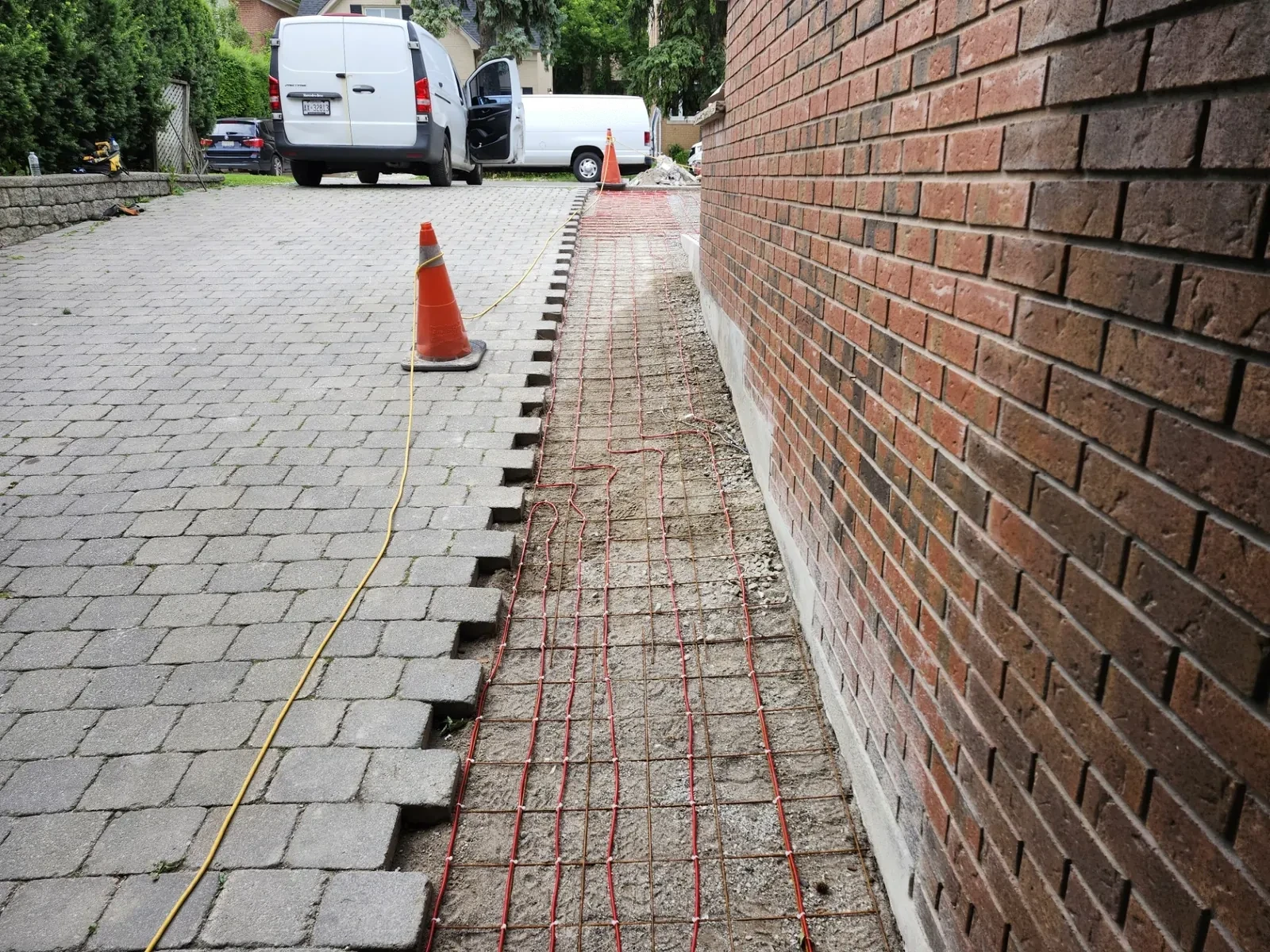
Cable is set in the bedding layer below the pavers, following the same layout drawing the rest of the system is designed around. Interlock is the friendliest surface for a retrofit: pavers can be lifted, the cable and sensor installed, and the same stone relaid, so you are not tearing out and replacing a driveway to get heat under it.
Concrete Driveways & Aprons
Cable is tied to the rebar or wire mesh so it sits inside the slab rather than against the base, then the concrete is placed over it. Someone needs to be on site during the pour watching the cable and checking resistance as the crew works, because a cable damaged by a rake or a boot disappears the moment the concrete goes down.
Walkways, Front Steps & Garage Aprons
The front walk and the steps are where people actually slip, and they are the smallest, least expensive area to heat. A lot of Toronto homeowners start here — steps, landing and the path to the sidewalk — and leave the driveway itself for a future resurfacing project.
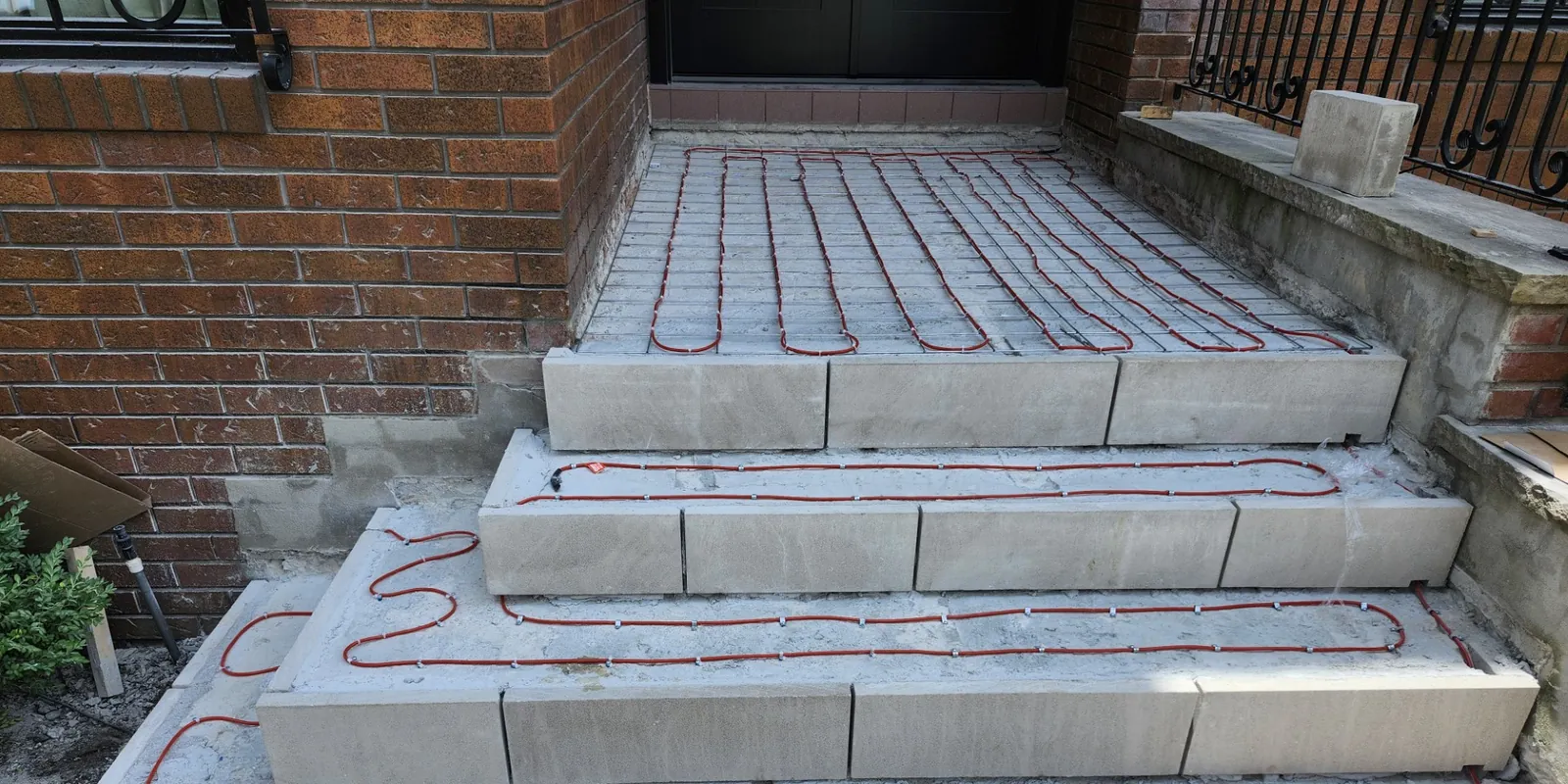
Heating cable run across a landing and stone steps before the treads go down. Steps and the walk to the door are the smallest area to heat and the place where ice actually hurts someone.
Cable secured to mesh in the prepared bed, with the interlock crew ready to close it up. This is the stage the whole schedule turns on — once the surface goes down, nothing can be changed.
Full Coverage or Tire Tracks?
Heating two strips under the wheel paths is the standard way to bring a long driveway within reach of a residential electrical service. It is a real trade-off, not just a cheaper option.
| Full Coverage | Tire Tracks | |
|---|---|---|
| Heated area | The entire driveway surface | Two heated strips under the wheel paths |
| Connected electrical load | Highest — every square foot is heated | Substantially lower than full coverage |
| Walking surface | Clear everywhere, including where you get out of the car | Snow stays between and beside the tracks |
| Best suited to | Short city driveways, walkways, steps, accessibility | Long or wide driveways where the goal is traction |
| Service upgrade likelihood | Higher — larger areas push the load calculation up | Lower, but still depends on the whole-house calculation |
| Adding the rest later | Not applicable | Means opening the surface again — decide before you pave |
A common Toronto compromise: tire tracks up the driveway, full coverage across the apron, the walk and the front steps. You get traction where the car goes and a clear surface where people walk.
Automatic Snow Sensors and Controls
A snow melting system is only as good as the thing deciding when to run it. This is where a system either quietly does its job or costs you money doing nothing.
Pavement Sensor
Set into the heated surface itself. Reads slab temperature and moisture, so the system runs when there is actually snow melting on the driveway rather than on a guess.
Aerial Snow Sensor
Mounted clear of the surface, it senses temperature and falling precipitation and can start the system while snow is still in the air.
Idle / Hold Setting
Keeps the slab just below its melting setpoint during a cold stretch so the system responds quickly when snow starts, instead of spending hours warming a frozen slab.
Afterrun Timer
Keeps heat on after the snow stops so meltwater dries off the surface instead of refreezing into a sheet of ice overnight.
Manual Override
A switch or app control to force a melt cycle, or to lock the system off entirely in the shoulder seasons.
Contactors & Control Panel
The controller does not switch the heating load directly. Contactors sized for the connected load do that, in a weatherproof enclosure with the required ground-fault protection.
What a Heated Driveway Needs From Your Electrical System
This is the part of the project most quotes skate over, and the part that decides whether your driveway plan is realistic.
- A load calculation on your existing service before anything is quoted — this is the step that decides whether the project needs a service upgrade.
- Dedicated circuits sized for a continuous load. Snow melting runs for hours at a time, and both conductors and overcurrent protection are sized on that basis.
- Large heated areas split into zones, each on its own circuit, rather than one enormous circuit.
- A contactor panel or subpanel to switch the heating load, in an enclosure rated for its outdoor or garage location.
- Ground-fault protection for the heating equipment, of the type and setting the Ontario Electrical Safety Code and the manufacturer's instructions call for.
- An underground feed from the panel to the outdoor control location — conduit, trenching and backfill.
- Sensor wiring run in its own conduit so a failed sensor can be replaced without opening the driveway.
- Bonding and weatherproof terminations everywhere the system leaves the building.
- ESA notification for the work, and coordination of the inspection.
Do I Need a 200 Amp Service?
Often, but not always — it depends on how much surface you are heating and what the rest of the house already draws.
Snow melting is one of the largest continuous loads you can add to a home, and the connected load climbs with every square foot of heated surface. A small heated walkway and set of front steps can sometimes fit on an existing 200 amp service that has headroom left in the calculation. A full driveway on a 100 amp service — in a house that also runs central air, a modern kitchen and an EV charger — generally does not, and a service upgrade becomes part of the project. Century homes still on 60 amps almost always need the service dealt with first.
The only real answer comes from a load calculation on your actual panel and your actual heated area. We do that before quoting, so the price you get already accounts for it — and if an upgrade is needed, it is priced as its own line rather than buried in the number.
Not sure what you have? Our guide to 100 amp versus 200 amp service in Toronto explains how to read what is already on your house, and how to read your electrical panel covers where to look.
Electric Snow Melting Compared With Hydronic
Both approaches work. For most Toronto houses the deciding factors are the size of the heated area and whether the property already has a boiler.
| Electric | Hydronic | |
|---|---|---|
| How it heats | Resistance heating cable embedded in the surface | Warm glycol pumped through PEX tubing in the surface |
| Equipment needed | Cable, controller, sensors, contactor panel, circuits | Boiler, pumps, manifold, expansion tank, glycol, plus its own electrical |
| Mechanical room space | None — the panel and controller are the only hardware | Needs room for a boiler and pump assembly |
| Up-front cost | Lower for typical residential driveways, walkways and steps | Higher — the mechanical package is the expensive part |
| Electrical demand | High. This is the main constraint on Toronto houses | Low — only pumps and controls draw power |
| Response time | Fast, especially with an idle setting holding the slab | Slower to come up to temperature from cold |
| Zoning | Straightforward — each zone is its own circuit | Done with manifolds and valves |
| Annual maintenance | None on the buried cable; controls and sensors get checked | Boiler service and glycol testing every year |
| Typical fit | Residential driveways, walkways, steps, garage aprons, condo entrances | Very large driveways and commercial surfaces already served by a boiler |
We install electric systems. If your property is better served by hydronic — a very large surface, or a building with a boiler already sized for it — we will say so, and we can still do the electrical for the boiler, pumps and controls.
What Drives the Cost of a Heated Driveway
We do not publish a price per square foot, because the number would be wrong for almost everyone. These are the things that actually move it.
Send photos of your driveway, your front steps and the inside of your electrical panel and we can give you a realistic range and tell you whether a service upgrade is likely — before anyone books a visit.
Why Snow Melting Suits Toronto Properties
Toronto does not get one clean freeze. It gets wet snow, a thaw, a refreeze overnight and a glaze of ice by morning — repeatedly, all winter. That cycle is harder on surfaces and on people than a straightforward cold snap, and it is the cycle a controlled snow melting system is designed for: melt the snow as it falls, then keep running long enough to dry the surface before the temperature drops back.
City lots make it worse. Short, steep driveways down to a rear garage, front steps in permanent shade, narrow side walks between houses, and nowhere to put the snow once you have moved it. Salt is the usual answer, and salt eats concrete, opens up interlock joints, kills the border planting and comes into the house on everyone's boots.
Heat removes the shovelling and the salt at the same time. For older owners, anyone with mobility issues, or a rental or managed property where somebody has to clear the walk before the tenants are up, it changes the winter entirely.
Where Ice Causes Problems
- Front steps and the landing at the door
- The last metre of driveway at the sidewalk, where the plow leaves a ridge
- Steep driveways where a car cannot get traction
- North-facing walks that never see sun
- Basement entrance stairs and window wells
- Garage aprons where meltwater runs back and refreezes
Heated area should always end at a drain or a grade break. Meltwater running off onto cold pavement just moves the ice a few feet downhill.
Repaving or rebuilding
your driveway this year?
That is the window for snow melting. Let's get the electrical planned before the crew is booked.
How We Install a Heated Driveway System
Thirteen steps, spread across your surface contractor's schedule rather than done in one visit.
Site Review
We look at the driveway, the walk, the steps, the panel and the route between them. Photos and measurements are often enough to start.
Decide the Heated Area
Full coverage, tire tracks, or steps and walkway only — and just as importantly, where the heat stops.
Load Calculation
We calculate the connected load against your existing service before quoting, so nobody is surprised later.
Written Scope & Estimate
A clear scope covering circuits, controls, trenching and inspection. Any service upgrade is priced separately and plainly.
Contractor Coordination
We get on a call with your paving, concrete or interlock contractor and agree the sequence and the dates before anyone mobilizes.
ESA Notification
The electrical work is filed with the Electrical Safety Authority and the inspection stages are booked into the schedule.
Trenching & Conduit
Underground conduit from the panel to the outdoor control location, with the sensor wiring in its own run.
Panel & Control Work
Dedicated circuits, contactor panel, ground-fault protection and the controller enclosure installed and wired.
Cable Layout
Cable is set out at the designed spacing and secured to mesh, rebar or the bedding layer. No cable is cut or shortened on site.
Testing at Every Stage
Resistance and insulation resistance are measured before the surface goes on, while it is going on, and after it is finished.
Sensors & Programming
Pavement and aerial sensors placed where they read real conditions, then the controller is programmed for the property.
Commissioning
We run every zone, verify current draw, trigger the sensors and confirm the system behaves the way it will in a storm.
Inspection & Handover
ESA inspection, documentation, and a walkthrough of the controller so you know exactly what it does and when.
Working With Your Paving or Landscape Contractor
Snow melting is one of the few residential jobs where the electrician and the landscaper have to be on site in the right order, on the right days. The cable is installed after the base is prepared and before the surface goes on — a window that is sometimes a single morning.
We talk to your contractor directly rather than through you. We agree who prepares the base, when the cable goes down, who is protecting it while the crew works, and when we come back to commission the system after the surface is finished. If you have not chosen a contractor yet, we are happy to be in that conversation early — the layout is easier to design before the base is built.
The same coordination applies indoors: our electric radiant floor heating work is scheduled around the tile setter for exactly the same reason.
Agreed Before Anyone Mobilizes
- Who prepares and compacts the base, and to what level
- The exact date and time window for the cable layout
- Who protects the cable during the pour or the paving
- Where the control enclosure and sensors land
- When the trench is open, and when it gets backfilled
- Which stages need to be seen before they are covered
- When we return to commission and test the finished system
10 Things to Know Before Installing a Heated Driveway in Toronto
The things we end up explaining on almost every estimate, in the order they tend to matter.
The cable goes in before the surface does
This is the one that catches people. A heated driveway is not something you add to a finished driveway — the heat has to be embedded in it. The realistic moment to do this is when the driveway is being paved, poured or relaid anyway.
It is an electrical project first
Snow melting is one of the largest continuous loads a house can carry. Before anything else happens, the connected load has to be calculated against your existing service.
A service upgrade is often part of the job
Plenty of Toronto homes are still on 100 amp services, and century homes on 60. Adding a heated surface on top of a modern kitchen, air conditioning and an EV charger frequently means upgrading the service first.
Tire tracks save money but leave snow behind
Two heated strips clear the wheel paths for traction. The snow between the tracks and beside the car stays where it is, and you still walk on it.
Sensors do more for you than cable brand does
Where the sensors sit and how the controller is programmed decide whether the system starts in time, stops at the right moment and dries the surface before it refreezes.
Decide where the heat stops
Meltwater that runs off a heated slab onto cold unheated pavement refreezes there. The heated area should end at a drain, a grade break or the street, not partway down a slope.
Your winter habits change
No chipping ice, no piles of salt. If you do clear anything by hand near a shallow heated surface, a plastic blade rather than a steel one is the safe habit.
Retrofits mean opening the surface
Interlock can be lifted and relaid. Asphalt and concrete generally cannot, which is why heated driveways are usually planned alongside a resurfacing or a rebuild.
Test the cable at every stage, not just at the end
A cable nicked by a rake and then buried under asphalt is a genuinely expensive problem. Measuring resistance before, during and after the surface goes on is how that gets caught while it can still be fixed.
Get everyone coordinated before the first truck shows up
The electrician, the paving or interlock contractor, the ESA inspection and, if the service is being upgraded, the utility all have to line up. Sorting that out on paper is far cheaper than sorting it out with a crew standing in your driveway.
Other Electric Heating We Install
Snow melting is one part of a wider category. The electrical fundamentals — dedicated circuits, ground-fault protection, controls and inspection — carry across all of it.
Electric Radiant Floor Heating
Heated floors under tile and stone in bathrooms, kitchens, basements and mudrooms — the indoor version of the same idea.
Heated floorsRoof & Gutter De-Icing
Heating cable along roof edges, valleys, gutters and downspouts to keep meltwater moving instead of building into an ice dam.
Electric heating overviewTrenching & Underground Conduit
The underground feed that gets power from your panel out to the driveway controls, the garage or the back of the property.
Underground conduitWhy Homeowners Choose Portman Electric
Portman Electric is an ECRA/ESA Licensed Electrical Contractor, Licence #7018049. Technical content on this page reviewed by Portman Electric.
Heated Driveway FAQs
Do heated driveways actually work in Toronto winters?
Yes, and the freeze-thaw pattern here is the case they are built for. A properly sized system keeps the surface above freezing during a snowfall so snow melts as it lands, and the afterrun setting keeps running long enough for meltwater to dry off instead of glazing over. When a system disappoints, the usual culprits are an undersized heated area, poorly placed sensors, or a controller left on its default settings.
How much does a heated driveway cost in Toronto?
There is no honest flat number for this, and anyone giving you one over the phone has not looked at your property. Cost is driven by heated square footage, whether you are heating the full surface or tire tracks, the surface material, the trenching distance from your panel, and whether your electrical service has the capacity or needs upgrading. We measure the area, run the load calculation and give you a written scope and price before any work is booked.
Do I need a 200 amp service for a heated driveway?
Often, but not always. It depends on how much surface you are heating and what the rest of the house already draws. A small heated walkway and set of front steps can sometimes fit on a 200 amp service that has room in the calculation. A full driveway on a 100 amp service, in a house that also has central air and an EV charger, usually does not — and a service upgrade becomes part of the project. A load calculation on your actual panel and your actual heated area is the only way to answer it properly.
Can you add snow melting to my existing driveway?
Only by opening the surface. Interlock is the practical case: the pavers are lifted, the cable and sensor are installed in the bedding layer, and the same stone goes back down. Asphalt and concrete effectively mean replacing the surface, so those projects are best timed with a resurfacing you were already planning.
What does it cost to run?
It depends on the heated area, how many hours the system actually runs, how the controller is set and what you pay per kilowatt hour. The controls are what keep that number sensible: with proper sensors the system runs during and shortly after snowfall rather than all winter, and zoning means you are not heating the whole driveway to clear the steps. We will walk through the connected load per zone with you so you can see what a melt cycle actually costs before you commit.
Will it melt ice, or only falling snow?
It will clear ice, but it takes longer than melting snow as it lands, because the system has to warm a cold slab and then a layer of ice sitting on it. This is what the idle setting is for — holding the slab just below its setpoint during a cold stretch so the system is not starting from frozen every time.
What happens during a power outage?
The system does not run, the same as any other electric appliance. If an outage lands in the middle of a storm you clear the surface the old way that day. If you have a standby generator, whether the snow melting system is on the backed-up load is a decision made during the generator design — most homeowners leave it off, because it is a very large load to carry on a generator.
Can I heat just the front steps and walkway?
Yes, and it is a sensible starting point. Steps and the path to the door are where people slip, the area is small, the connected load is manageable, and the work often fits alongside a landscaping or masonry project you are already doing.
Does snow melting damage asphalt, concrete or interlock?
Not when the cable is rated for the surface it is embedded in and installed at the spacing the manufacturer specifies — cable for asphalt, for example, has to tolerate the temperature of the paving as it goes down. It also reduces your reliance on salt and a steel shovel, and salt is hard on both concrete and interlock joints.
How long does the electrical work take?
The panel and control work is typically a day, sometimes two if a subpanel or a service upgrade is involved. Trenching depends on the distance and what is in the way. The cable layout happens on the paving contractor's schedule, and final commissioning happens after the surface is finished, so the project is spread across the surface schedule rather than done in one continuous visit.
Do you need a permit?
The electrical work is done under an ESA notification and inspected by the Electrical Safety Authority — we file it and coordinate the inspection. Permits for the driveway surface itself, or anything involving the city boulevard or curb, are handled by your paving or landscape contractor.
How long do the heating cables last?
Buried heating cable has no moving parts and is not a wear item, and manufacturers back their cable with their own warranty terms — we will give you the specific terms for the system you choose rather than a number we made up. In practice the failures that do happen are physical damage during installation, which is exactly why the cable is tested before, during and after the surface goes on.
Can I control it from my phone?
Yes, if you choose a controller with that capability. Remote control is genuinely useful here — you can start a melt cycle before you drive home, or check that the system ran while you were away.
Do you supply the heating cable, or does my contractor?
Either works. If you or your landscape contractor have already chosen a system, we install the electrical to suit it and follow that manufacturer's layout and instructions. If you would rather we handle it end to end, we will spec a system for the area and surface and include it in the quote.
Get an Estimate for a Heated Driveway in Toronto
Send photos of your driveway, your front steps and the inside of your electrical panel, and tell us roughly when the surface work is happening. We will come back with the heated area we would recommend, whether your service can carry it, and what the electrical scope looks like.
ECRA/ESA Licence #7018049 · Licensed Electrical Contractor · Toronto & the GTA
Related Services